Alexandrite: The Color-Changing Gemstone That’s Worth Every Penny
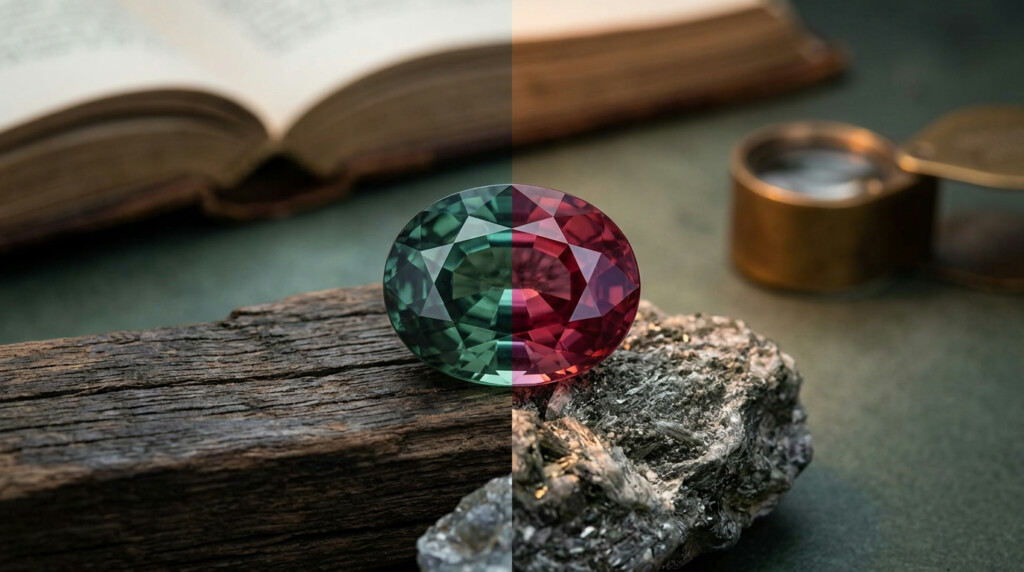
The first time I watched an alexandrite change color, I thought something was wrong with my eyes.
I was in a small gem shop in Bangkok — the kind of place with no sign, just a narrow staircase and a dealer who seemed mildly annoyed that I'd found my way up. He dropped a loose stone into my palm, roughly the size of a pea. Under the shop's fluorescent ceiling, it was a deep, mossy green. Then he clicked off the lights and handed me a small LED torch.
The stone turned red.
Not pink. Not purplish. Red. Like a ruby had somehow been hiding inside a piece of jade.
That's alexandrite. And if you've never seen a fine specimen change color with your own eyes, no photograph or description will quite prepare you for it.
What Is Alexandrite?
Alexandrite is a variety of the mineral chrysoberyl — the same family that gives us cat's eye stones. What makes alexandrite extraordinary is a quirk of its chemical composition: it contains chromium, the same trace element that makes rubies red and emeralds green.
In alexandrite, that chromium sits in a crystal structure that absorbs light in a very specific way. Daylight (which is rich in blue and green wavelengths) causes the stone to appear green. Incandescent or candlelight (which is richer in red wavelengths) shifts the perception toward red. The human eye, caught between these two dominant wavelengths, reads the stone as green in one light source and red in another.
It sounds like a magic trick. It is, in a sense. Just a very old, very geological one.
A Brief History: Named for a Tsar
Alexandrite was first discovered in 1830 in the emerald mines of the Ural Mountains in Russia. According to the most popular account, the stone was identified on the birthday of Tsar Alexander II — hence the name.
The timing may have been convenient mythology, but the symbolism was real: alexandrite's red and green colors happened to mirror the military colors of Imperial Russia. The stone became enormously fashionable among Russian aristocracy, and Fabergé used it extensively in jewelry throughout the late 19th century.
When the original Russian deposits were largely exhausted by the early 20th century, alexandrite became something of a collector's ghost — everyone knew it existed, but true fine specimens practically disappeared from the market.
Then, in 1987, a significant deposit was discovered in Minas Gerais, Brazil. Other sources followed: Sri Lanka, East Africa, India. Today, alexandrite is still rare, but not unobtainable — and the market has evolved enough that buyers at various price points can find something genuine.
The Color-Change Effect: What "Good" Actually Looks Like
Not all alexandrites change color equally, and this is where the difference between a mediocre stone and a spectacular one becomes stark.
Gemologists evaluate alexandrite's color change on a rough scale. A stone that shows "100% color change" — shifting dramatically and cleanly from green to red with no muddiness — is exceptionally rare and priced accordingly. More commonly, you'll see:
Strong (75-100% change): These are the stones that genuinely stop people in their tracks. Green in daylight, deeply red or purplish-red in incandescent light. Almost no grey or brown muddiness. These command premium prices.
Moderate (50-75% change): The color shifts clearly between light sources, but the green may be bluish or the red may lean more toward purple. Still genuinely beautiful, and much more accessible in terms of pricing.
Weak (under 50%): The stone might shift from olive to pinkish, or show a subtle hue change that requires you to look carefully. Sometimes sold as alexandrite-effect stones, which is technically accurate but can mislead buyers expecting dramatic transformation.
For everyday buyers, a moderate color-change alexandrite with good clarity is a more realistic sweet spot than chasing a perfect specimen that may cost more than a car.
Where Does Alexandrite Come From Today?
Brazil produces some of the most saturated alexandrites on the market — the Brazilian material often shows that vivid green-to-red shift that matches historic Russian stones. It also tends to command the highest prices for top-quality material.
Sri Lanka has been producing alexandrite for centuries. Sri Lankan stones often lean more toward yellowish-green in daylight and brownish-red in incandescent light. The color change is generally less dramatic but the stones tend to be cleaner and larger.
East Africa (Tanzania, Zimbabwe, Madagascar): African alexandrite varies enormously. Some of the finest stones on the current market come from East Africa — strong color change, excellent saturation. Quality is inconsistent, which makes knowing your dealer important.
India: Indian alexandrite often shows a teal-to-purple shift rather than a classic green-to-red. It's genuine alexandrite but presents a different color character.
Russia (vintage/antique): If you encounter a piece described as "Russian alexandrite," treat the claim with healthy skepticism. While genuine Russian alexandrite exists on the antique market, most pieces sold with that label are either synthetic, misrepresented, or from other sources. Original Russian material is exceptionally rare in fine quality today.
Natural vs. Synthetic: An Important Distinction
Here's something most jewelry salespeople won't lead with: high-quality synthetic alexandrite exists, and it's been produced since the 1970s. Lab-grown alexandrite can show spectacular color change — often better than most natural material — and it's far more affordable.
Whether you want natural or synthetic is a legitimate personal choice, but you should know which one you're getting. The problem is that some dealers sell synthetic alexandrite as "Russian alexandrite" or simply as "alexandrite" without disclosing the origin.
If you're spending serious money on alexandrite, ask directly: "Is this natural or lab-created?" A reputable dealer will tell you without hesitation. If they hedge or get vague, walk away.
For buyers who want the color-change experience without the price of a fine natural stone, lab-grown alexandrite is genuinely worth considering — particularly for everyday jewelry that will see real wear.
Alexandrite as the June Birthstone
Alexandrite is one of three birthstones for June, alongside pearl and moonstone. (June is one of the few months that gets multiple options, perhaps because the original birthstone lists recognized how rare alexandrite was becoming.)
For June birthdays, alexandrite makes a particularly meaningful gift — it's unusual, immediately memorable, and has a story worth telling. The color-change effect is endlessly fascinating to people who've never seen it, which means anyone who receives alexandrite jewelry will spend years explaining and demonstrating it to friends.
Shopping for Alexandrite Jewelry: What to Look For
1. Ask for the stone in both light sources. If you're shopping in person, bring the stone to a window (daylight) and then view it under the shop's incandescent lighting. Never buy alexandrite without seeing the color change happen in front of you.
2. Look for documentation. Fine natural alexandrite — anything over 1 carat with strong color change — should ideally come with a certificate from a respected gemological laboratory (GIA, AGL, or Gübelin are the gold standard). The certificate will note whether the stone is natural, its origin if determinable, and any treatments.
3. Expect inclusions. Eye-clean natural alexandrite is genuinely rare. Minor inclusions visible under magnification are normal and don't significantly affect a stone's beauty or value. What you don't want is inclusions visible to the naked eye that affect transparency or structural integrity.
4. Consider the setting. Alexandrite is a relatively hard stone (8.5 on the Mohs scale), making it suitable for rings and everyday wear. The color-change effect is best displayed in open settings that allow light to enter from multiple angles. Bezel settings, while protective, can slightly mute the color interaction.
5. Price as a reality check. Natural alexandrite with a strong color change in even a modest size (0.5 to 1 carat) will cost anywhere from $3,000 to $15,000+ per carat depending on quality. If someone is offering you a "1-carat natural alexandrite with 100% color change" for $200, it is synthetic, treated, or misidentified. Period.
Why People Fall in Love with Alexandrite
Part of alexandrite's appeal is deeply practical: you genuinely get two different jewels in one. Wear the ring to lunch in natural light and it's green. Wear it to dinner by candlelight and it's red. The stone transforms with the occasion without you changing a thing.
But there's something more than utility at work here. Alexandrite is one of the few gemstones that actively does something — it participates in your experience of light and environment. It's not static. It responds.
For people who find conventional gemstones a little too passive, too much like display objects, alexandrite feels different. It's a stone that rewards attention.
Frequently Asked Questions
Is alexandrite expensive?
Fine natural alexandrite is among the most expensive colored gemstones per carat — comparable to top ruby, sapphire, or emerald. Lab-created alexandrite is much more affordable while retaining the color-change effect.
Is alexandrite rare?
Yes. Fine-quality natural alexandrite with a strong color change is genuinely rare. Significant sources are limited, and stones over 1 carat with clean clarity and vivid color change are collector-level finds.
What's the difference between alexandrite and alexandrite-effect stones?
"Alexandrite-effect" typically refers to synthetic or simulated stones that mimic the color change but aren't chemically chrysoberyl. True alexandrite — natural or lab-grown — is chrysoberyl with chromium.
Can I wear alexandrite every day?
Yes. At 8.5 on the Mohs hardness scale, alexandrite is durable enough for daily wear. Avoid ultrasonic cleaners and steam cleaning; warm soapy water and a soft brush is the safest cleaning method.
What should I pay for alexandrite?
For natural alexandrite: budget at least $500-$1,500 for a modest stone with moderate color change, and significantly more for anything with strong color change or above 0.5 carat. Lab-created alexandrite with excellent color change can be found for $50-$300 depending on size and setting.
Alexandrite is one of those gemstones that doesn't need marketing. It markets itself, the moment someone sees it change.
If you've been curious about it, go find one in person. Ask the dealer to show it to you in different light sources. Watch what happens.
You'll understand immediately why people have been enchanted by this stone for nearly two centuries.
